
Pasquotank Court Records After Arrest
After a Pasquotank County arrest, the custody record and the court record move through different systems. Albemarle District Jail and VINELink answer whether a person is currently in local custody. The North Carolina Judicial Branch, the Pasquotank County Clerk, and the eCourts Portal answer what criminal case was filed, what charges are pending, when court is scheduled, and what happened to the case.
The District Attorney for Prosecutorial District 1, Jeff Cruden / Jeffrey Cruden, represents the State in criminal prosecutions for Pasquotank and nearby counties. The DA's role matters because booking charges can change. Prosecutors may file, amend, reduce, dismiss, supersede, or indict charges after the arrest. The jail record is a custody snapshot. Court records after a jail arrest are the legal case file.
For custody and booking context, use the Pasquotank County jail inmate records page. For booking-photo limits, use the Pasquotank County jail mugshots page.
Search Court Records After Arrest
The North Carolina eCourts Portal is the public online route for case information, court dates, payments, and Smart Search. The Judicial Branch Pasquotank County page also links users to court dates, criminal calendars, and court services. For full or certified records, use the Clerk of Superior Court because a portal result is not the same as a certified court record.
- Open eCourts Portal and choose Smart Search.
- Enter a record number or a name in Last, First Middle Suffix format.
- Use Advanced Filtering Options and select Pasquotank County under location.
- Review case number, case type, file date, hearings, party information, and status.
- Contact the Pasquotank County Clerk for paper files, certified copies, or records not clear in the portal.
The Judicial Branch Pasquotank County page is the official county court landing page for court services and search links.
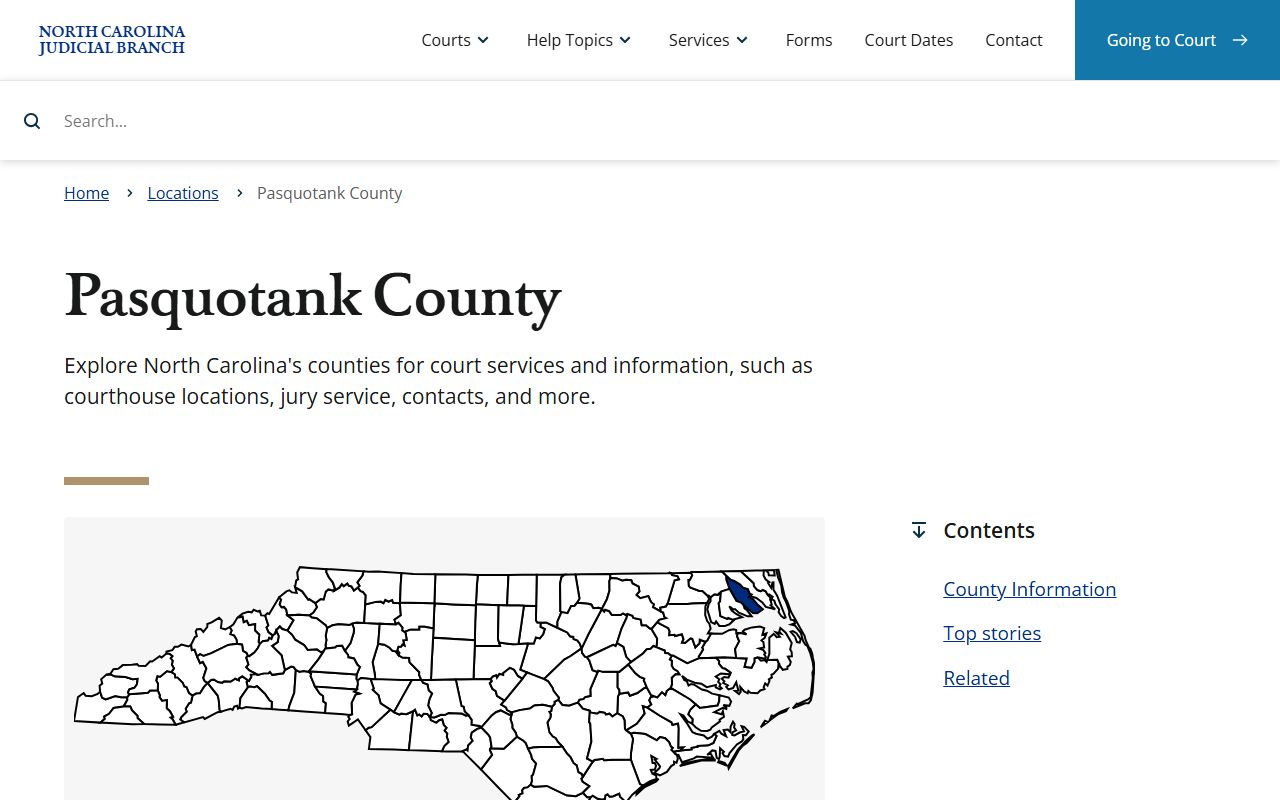
That county court page is the safer starting point for official court services than third-party arrest-record sites.
Pasquotank Court Records Search Fields
eCourts Smart Search supports a basic record-number or name search and more detailed filters. The research capture shows Pasquotank County as a location option. Wildcard rules matter: case-number wildcard search requires at least four characters, business name or nickname search uses a minimum four characters plus an asterisk, and name wildcard search needs at least three characters for the last name plus an asterisk and at least one for the first name.
| Field Label | Type | Required | Notes |
|---|---|---|---|
| Record Number or Name | Text | Yes for basic search | Use Last, First Middle Suffix format for names. |
| Last Name / First Name | Text | Conditional | Required for separated party-name search. |
| Filter by Location | Dropdown or multiselect | Optional | Select Pasquotank County to narrow results. |
| Date of Birth From / To | Date | Optional | Helps separate common names. |
| SO Number / Booking Number | Text or filter | Optional | Useful only when reliable from court or jail paperwork. |
| Case Type / Case Status / File Date | Filters | Optional | Use to narrow filed criminal cases. |
Charges Filed After an Arrest
Booking starts at the jail, but formal court charges are filed through criminal process. In Pasquotank County, the prosecutor's office handles criminal prosecutions in District and Superior Courts and prepares the criminal trial docket. Returned arrest warrants, indictments, and criminal summonses are public court records unless sealed or restricted by law. The form of the charging document depends on the case type and stage.
| Document | What It Does | Pasquotank County Use |
|---|---|---|
| Complaint or magistrate process | Starts or supports an initial criminal allegation. | May connect the arrest and first appearance to a court case. |
| Criminal information or filing | Prosecutor-filed charge document in appropriate cases. | Shows charges pursued by the State after review. |
| Indictment | Grand jury charging instrument, often in felony matters. | Can supersede or formalize charges in Superior Court. |
| Criminal summons | Requires appearance without immediate arrest in some cases. | Public when returned unless sealed or restricted. |
Pasquotank Charge Status Records
Charges can change after a Pasquotank County arrest. A jail booking entry may reflect arrest allegations or warrant language. Later court records may show an amended charge, a reduced charge, an indictment, a dismissal, or a final disposition. This is why court records after arrest should be checked by case number and charge line, not only by the first booking label.
| Status | Meaning |
|---|---|
| Pending | The case remains open and has not reached final disposition. |
| Amended | The charge or filing has been changed after the original filing. |
| Reduced | A prosecutor or court action lowered the charge level or offense. |
| Dismissed | The charge ended without conviction on that charge. |
| Indicted | A grand jury charging document has been filed for a felony matter. |
| Disposition | The current or final outcome, such as guilty, dismissed, or not guilty. |
Bond Records After Arrest
Bond and release conditions appear near the arrest-to-court transition. G.S. 15A-534 allows written promise to appear, unsecured appearance bond, custody release, secured appearance bond, and other conditions. Magistrates can set initial conditions when release is allowed. Pasquotank court contacts list Magistrates at (252) 331-4599 and the Clerk of Superior Court at (252) 331-4600.
| Bond Type | How It Reads in Practice |
|---|---|
| Written promise | Release based on a signed promise to appear. |
| Unsecured bond | No upfront security, but the amount can become owed if the person fails to appear. |
| Secured bond | Money, property, or surety must satisfy the order before release. |
| Surety bond | An authorized bondsman or surety posts under North Carolina rules. |
| No-bond or hold | Release may be blocked by the charge, another warrant, probation, federal, ICE, or court hold. |
Warrants and Court Records
Pasquotank County Sheriff's Office publishes a Most Wanted page, but no official searchable active-warrant database was located in the reviewed research. The Most Wanted page is a public tip page, not a full warrant list. For a possible active warrant, contact the Sheriff's Office, Clerk, or Magistrates depending on whether the question is law enforcement execution or court process.
North Carolina law matters after a warrant is returned to court. G.S. 132-1.4 treats returned arrest warrants, search warrants, indictments, criminal summonses, and nontestimonial identification orders as public court records unless sealed. eCourts Smart Search can help find a filed case or returned process, but an active warrant question may still require direct contact.
Charges vs Convictions
An arrest and a charge are not convictions. A charge is an accusation or filed offense that must move through court. A conviction is the result of a guilty plea, verdict, or other court outcome that supports judgment. Pasquotank County court records after arrest should be read with that difference in mind, especially when a case is pending or a charge has been dismissed.
| Charge | Conviction | |
|---|---|---|
| Stage | Allegation or filed offense | Final finding or plea outcome |
| Where shown | Booking paperwork, warrant, eCourts, clerk file | Court disposition and judgment records |
| Can change? | Yes, it may be amended, reduced, dismissed, or indicted | Changes only through lawful court action |
Sealed and Expunged Records
North Carolina expunction law can make eligible court records confidential. G.S. 15A-151 governs confidential files and exceptions after expunction. An expunction does not mean every private copy disappears, and it does not change the need to verify the official court file with the clerk. Sealed or restricted records may also be unavailable to the public through normal portals.
| Sealed | Expunged | |
|---|---|---|
| Public access | Hidden or restricted by court order or law | Made confidential under the expunction statute |
| Official location | Still controlled by the court or agency | Retained in confidential files under statutory rules |
| Best verification route | Clerk of Superior Court | Clerk of Superior Court or counsel |
Pasquotank Public Records Requests
The Judicial Branch court-records guide says criminal case information can be accessed at public self-service terminals in a clerk's office. Searches may be by defendant name, case number, or victim or witness name. Paper files are accessed in the county where the case is located, and copies may be made for a fee. The same guide points police reports back to the law-enforcement agency, not the court.
For a certified single-county criminal record search, the North Carolina Judicial Branch uses AOC-CR-314 through the clerk with a $25 fee. For Judicial Branch public records, use the Judicial Branch public-records request page. Agencies do not have to create or compile a record that does not exist under G.S. 132-6.2.
Important: Court records may be incomplete in online view, so certified use should go through the Clerk of Superior Court.
Public Record Search
Sponsored Results